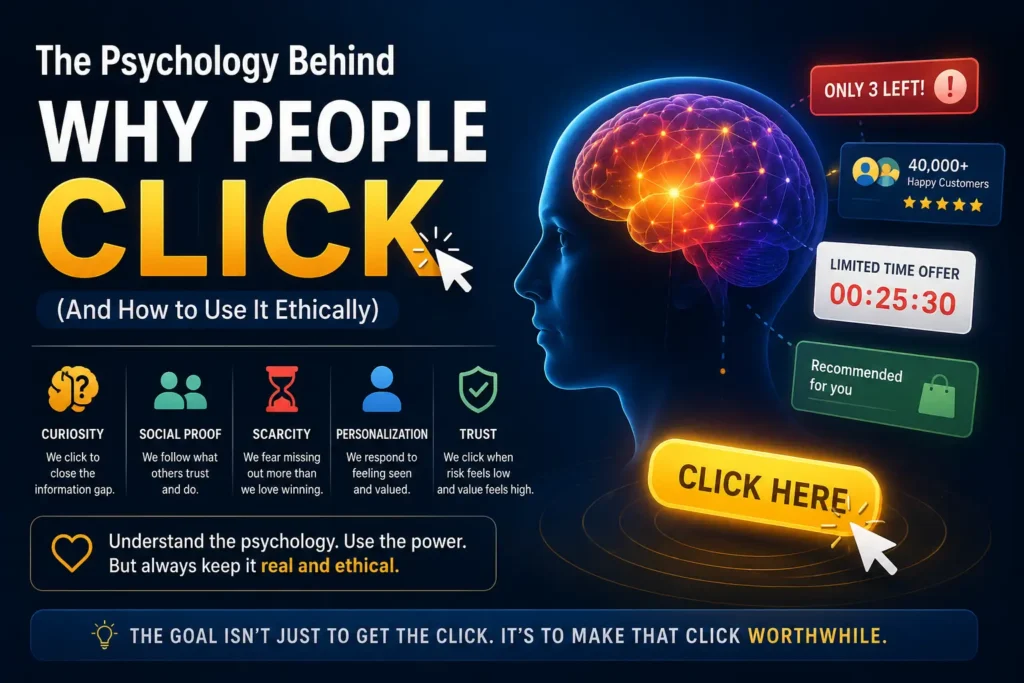
The Psychology Behind Why People Click (And How to Use It Ethically)
The Psychology Behind Why People Click (And How to Use It Ethically) The Psychology Behind Why People Click (And How to Use It Ethically) Have you ever clicked on something and then, a second later, wondered why? Maybe it was a headline that made your stomach drop a little. Maybe it was a bright red banner screaming ‘Only 2 left in stock! badge. Maybe it was just a photo of a stranger’s face looking directly at you. Whatever it was, something in your brain made the decision before your conscious mind even caught up. That’s the secret marketers have known for decades: clicking isn’t really a logical decision. It’s an emotional one that gets justified with logic afterward. So here’s the real question this whole post is built around: What is actually happening in someone’s brain in the half-second before they click and how can you use that knowledge without turning into the kind of marketer people learn to hate?Let’s break it down. Why do we click before we think? Ever notice how you can decide to click something almost instantly, but take five minutes to decide what to order at a restaurant? That’s because clicking is a low stakes, high reward action. Your brain treats it almost like a game: tap this, get a hit of information, dopamine, or relief from curiosity. Behavioral psychologists call this a micro reward loop and it’s the same mechanism that makes slot machines and social media feeds so addictive. The click itself costs nothing. So your brain doesn’t run it through the same risk-analysis it uses for bigger decisions. It just asks one question: Does this feel interesting, urgent, or relevant to me right now?”If the answer is yes, you click. The thinking happens after Why does curiosity feel almost impossible to resist? Here’s a question for you: which of these headlines makes you want to click more? 1. 5 Email Marketing Tips2. The Email Mistake That’s Quietly Killing Your Open Rates Most people pick the second one not because it promises more value, but because it creates a curiosity gap: a small, uncomfortable space between what you know and what you want to know. Psychologist George Loewenstein described this in his information gap theory: curiosity isn’t about how interesting something is it’s about the gap* between our current knowledge and a piece of missing information we’ve been told exists. Our brains treat that gap almost like an itch. Clicking is how we scratch it. This is why you won’t believe what happened next headlines worked for so long. That wasn’t good writing at play that was a gap, built on purpose. Imagine landing on two different pages. One simply says ‘Buy Now.’ The other says ‘Trusted by over 40,000 marketers who’ve already made the switch.’ Which one makes you hesitate less?” This is social proof one of the oldest psychological triggers in marketing, formalized by Robert Cialdini. Humans are wired to look at what others are doing as a shortcut for is this the right decision? It’s a survival instinct This goes deep into our evolutionary wiring following the crowd used to be a matter of life or death, not just convenience.That’s why testimonials, review counts, “trending now” labels, and follower counts work so well. They don’t just build trust they lower the perceived risk of clicking or buying. Why does only 3 left in stock make us panic buy? Ask yourself honestly: have you ever bought something *specifically because* it said it was almost sold out even if you weren’t sure you needed it? That’s scarcity and its cousin, loss aversion. Research by Daniel Kahneman and Amos Tversky found that people feel the pain of losing something roughly twice as strongly as the pleasure of gaining something equivalent. That’s why marketing copy built around ‘don’t miss out’ tends to hit harder than copy built around ‘here’s what you’ll gain.Countdown timers, limited seats, “offer ends tonight” banners they all borrow the same trigger: the fear of missing out weighs more than the desire to win. Why do small, personal details make us feel special? Have you ever opened an email that used your first name in the subject line and felt a tiny jolt of oh, this is for me? That’s the reciprocity and personalization effect. When something feels tailored to us specifically even in a small way our brain interprets it as a signal of relationship, not just transaction. We’re more likely to reciprocate attention with attention, and a click is the cheapest form of reciprocity there is. This is why personalized subject lines, dynamic content, and “recommended for you” sections consistently outperform generic ones. So where’s the line between psychology and manipulation? Here’s the uncomfortable truth: every trigger above curiosity, social proof, scarcity, personalization can be used to genuinely help someone make a better decision faster, or to trick them into a decision they’ll regret. The difference isn’t the technique. It’s the intent and the truth behind it. Ask yourself these questions before you publish anything: Is the urgency real? If that timer resets the moment someone new shows up, you’re not signaling scarcity anymore you’re fabricating it. Is the curiosity gap honest? A headline should promise something the content actually delivers, not something engineered purely to bait a click.Would this still feel okay if the person on the other end knew precisely why you built it this way?If the answer is no, that’s your answer.Does this help them decide, or does it prevent them from deciding clearly? Ethical persuasion clarifies. Manipulation obscures. The marketers who win long term aren’t the ones who found the cleverest dark pattern. They’re the ones who understood psychology well enough to respect it using real scarcity, real social proof, and real curiosity to help the right customer find the right thing, faster.